E-Books
CX Use Cases for Applying the Voice of the Customer

2 November 2025
In customer experience (CX), the costliest risks are rarely loud. They deafen in the silence between what brands promise and what customers feel: 91% of business leaders believe they deliver CX as intended, but less than 40% of customers agree.
For many years, the “voice of the customer” has been perceived as a checkbox exercise: Collect feedback, count responses, and hope the numbers improve next quarter. This no longer holds up today where expectations can shift overnight, brand loyalty is fragile, and competition is only a swipe away.
The voice of the customer (VoC) should be seen as an intelligence layer, a way of listening, interpreting, and acting on what customers say across every channel and every moment of their journey. It lives in chatbot conversations after hours, the sentiment behind one-star reviews, the frustration buried in a support ticket, and even in social media mentions.
Every company might be collecting this unstructured data, but the advantage lies in what they do with it. Companies with effective VoC programs outperform their peers, achieving 7.3x greater year-over-year (YoY) revenue, 18% more retention, and 23.9x increase in customer satisfaction (CSAT).
How a modern VoC solution works
A modern VoC solution can be seen as a system that turns raw, structured, and unstructured feedback into actionable intelligence. The specific steps vary depending on organizational maturity, operational readiness, and analytical capability, but most follow a similar flow.
It begins with data collection and scoping, where feedback is aggregated from multiple sources. This includes structured inputs, such as surveys and NPS scores, as well as unstructured data from call transcripts, chat logs, social media posts, and app reviews. A broad intake ensures that the full spectrum of customer sentiment is captured.
The next stage is data extraction and exploration, where inputs are processed into structured metrics like sentiment scores, topic frequencies, and satisfaction ratings. These metrics provide a baseline view of what customers are saying and where their experiences diverge from expectations.
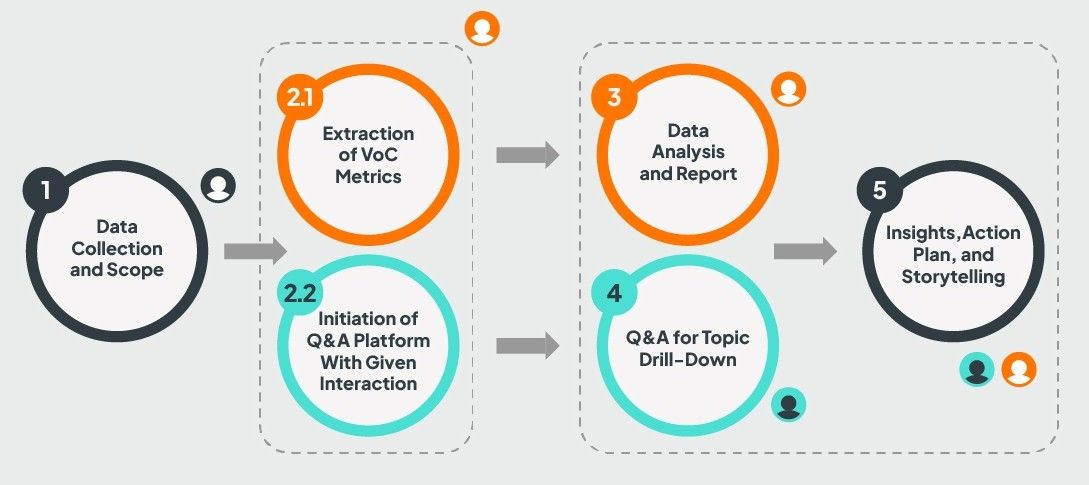
More advanced VoC solutions extend this stage with interactive, AI-powered exploration. that helps democratize access to insights.
The process moves into analysis and insight generation. Here, organizations can surface patterns, cluster feedback themes, and link sentiment trends to business KPIs. Advanced implementations might include AI-driven capabilities.
The final stage is activation, where findings are translated into decisions and actions. How far this goes depends on the organization’s capability and readiness. Effective VoC programs, for example, can feed directly into product sprints to help decide which features to fix, enhance, or build next. They can flag specific breakdowns in service delivery that need attention, such as unclear escalation paths or slow resolution times. VoC-driven insights could also pinpoint where teams need targeted training and validate whether operations remain aligned with regulatory requirements.
Download the e-book and explore how VoC can guide business decisions that shape better experiences across five industries: FinTech, e-commerce, retail, telecommunications, and government.
![[E-book] Creating Powerful CX in the Age of AI](https://cms.tdcx.com/uploads/TDCX_e_Book_Landing_Page_image_d8fde25831.webp)
![[E-book] Rethinking Fintech Customer Experiences](https://cms.tdcx.com/uploads/0287f75b3558465bb611fe6b3e3aa3e6_08bcbc8ef0.jpg)
![[E-book] Future CX Talent Strategies](https://cms.tdcx.com/uploads/ec1f55748b464f0eb6e7e498b4dfa548_79df84fbad.jpg)