Blogs
2026 Predictions for AI: Enabling the Future in an Agentic Economy

7 December 2025
By Lianne Dehaye
Senior Vice President - TDCX AI
Where will the next trillion dollars of enterprise value come from?
Boardrooms, investment decks, and technology road maps point to AI, generative AI (GenAI), and agentic AI. Long-term productivity is estimated at US$4.4 trillion, driven by “superagent” systems that plan tasks, anticipate needs, and execute decisions with autonomy that sounded implausible three years ago.
Forecasts show that 67% of next year’s US$227-billion spend will go to embedding AI into core products, operations, and customer-facing systems. Not proofs of concept, demos, or innovation labs, but operational integration that changes how businesses run.
Last year showed the promises, and 2025 revealed how fast those possibilities could expand. The functions that AI touches became more augmented, adaptive, and agentic, carrying pieces of the business with consistency. In fact, 62% of organizations, especially those in technology, media and telecommunications, and healthcare, are now piloting AI agents, expecting them to own and orchestrate repeatable decisions.
Early adopters, however, are learning that once AI decides, coordinates, and executes, it becomes an economic force. This marks the rise of the “agentic economy,” a shift from automated assistance to coordinated execution. Analysts estimate that in Asia Pacific, 50% of new economic value generated by digital business by 2030 will come from companies building this kind of AI today.
What does this mean for customer experience (CX) in 2026 and beyond? CX is often where enterprises test the agentic economy, and whether AI enhances interactions, reshapes roles, or reveal its limits.
From improving efficiency to creating value: The challenges of navigating the agentic economy
The agentic economy is emerging from three converging forces reshaping how organizations think about technology, operations, and value creation:
- Ceiling of automation: It has powered efficiency for decades, but it was built for predictability that today’s customer journeys no longer mirror. They now span devices, languages, and cultures. The next leap won’t be more rules-based automation, but systems that learn, adapt, and respond to nuance in real time.
- GenAI adding new pressure on CX and the workforce: Its promise of creativity often clashes with the realities of specific markets, regulations, or customers. In 2026, nearly half of AI-powered apps in Asia Pacific will miss their ROI targets and 40% of agentic AI projects will be cancelled by 2027. It’s not a failure of the technology, but a mismatch in business needs and systems trained on “everything.”
- Leadership priorities: Efficiency is no longer the aspiration. Measurable value is now the baseline. In 2026, 70% of G2000 CEOs will ask how AI won’t simply cut costs, but actively drive expansion, retention, and revenue.
Business value remains uneven, however. Optimism is high, but the economics haven’t caught up. Only 39% of organizations today report any profit from AI. Leaders want outcomes that justify continued investment.
Maturity is also inconsistent. Adoption is widespread, yet two-thirds of organizations are still stuck in pilots or patching AI onto legacy workflows, leaving both CX and human roles underprepared.
Context is equally critical. Generic AI rarely handles real-world complexities. It’s why by 2027, 40% of organizations will invest in AI-infused data architectures to support domain-specific language models (DSLMs), aiming to make smarter decisions for improving CX and empowering the workforce.
These gaps shape the path forward to an agentic economy. CX and business leaders must now navigate them together, ensuring that AI deliver accountable value, operates with domain-specific intelligence, and integrates with workflows redesigned (not retrofitted) for agentic execution.
How can leaders turn these challenges into momentum? It will depend on how they measure ROI, build domain expertise, and accelerate organizational maturity.
Measure ROI beyond hype: From experimentation to accountable value
The agentic economy introduces systems that act, escalate, coordinate, and decide, all of which require a higher standard of proof. Leaders need a framework that defines why an AI deployment exists, what outcome it must advance, and how its performance will be measured. McKinsey’s 2025 research illustrates this: 88% of companies use AI somewhere, yet only a third have scaled it successfully. Many also rolled back deployments when returns failed to materialize.
ROI must guide AI from the start, not after the launch. In an agentic economy, growth-oriented ROI shows up in the experience layer. Retention improves when issues are intercepted early. Conversions increase when actions adapt to the customer. Churn decreases when friction is removed. Operationalizing these need a different leadership posture:
- Define value at the problem, not the technology. Focus on where delay, inefficiency, or ambiguity creates measurable loss.
- Make ROI measurable before an AI system goes live. Every deployment should start with baselines, targets, variance ranges, and sunset thresholds.
- Tie autonomy to impact. Agentic systems should not be seen as a panacea simply because they can perform a task. They should demonstrate reliability and accuracy. This staged approach to autonomy accelerates adoption because it protects trust, which allows agentic AI to expand its role within an organization.
When ROI becomes the first filter, teams prioritize high-impact use cases, strengthen governance, and accelerate scaling. AI, GenAI, and agentic AI can work together to become a sustainable source of revenue, loyalty, and resilience. As they handle more decision-making, however, roles will inevitably shift and leaders must plan how their employees will adapt and stay effective.
Strengthen context and accelerate maturity: Building the foundations for AI to create value
The next wave of AI maturity will be defined by specificity. Generic models can summarize or interpret a support ticket, but it cannot safely adjudicate a refund tied to region-specific refunds, enforce loyalty rules, or comply with regulations. Enterprises must shift to DSLMs tuned to their vocabulary, workflows, risks, and regulatory requirements. In fact, more than 60% of enterprise GenAI models will be domain-specific by 2028.
Technology alone is not enough. Analysts project that by 2029, agentic AI will autonomously resolve up to 80% of common customer-facing issues, yet only 5% of companies managed to integrate AI into workflows at scale this year. Broken processes, inconsistent data, siloed teams, and unclear ownership block AI from delivering value.
Leaders can adopt an AI maturity framework that assesses readiness across strategy, people, processes, and technology. It helps identify gaps, prioritize interventions, and sequence investments so that AI is not just deployed, but scaled effectively.
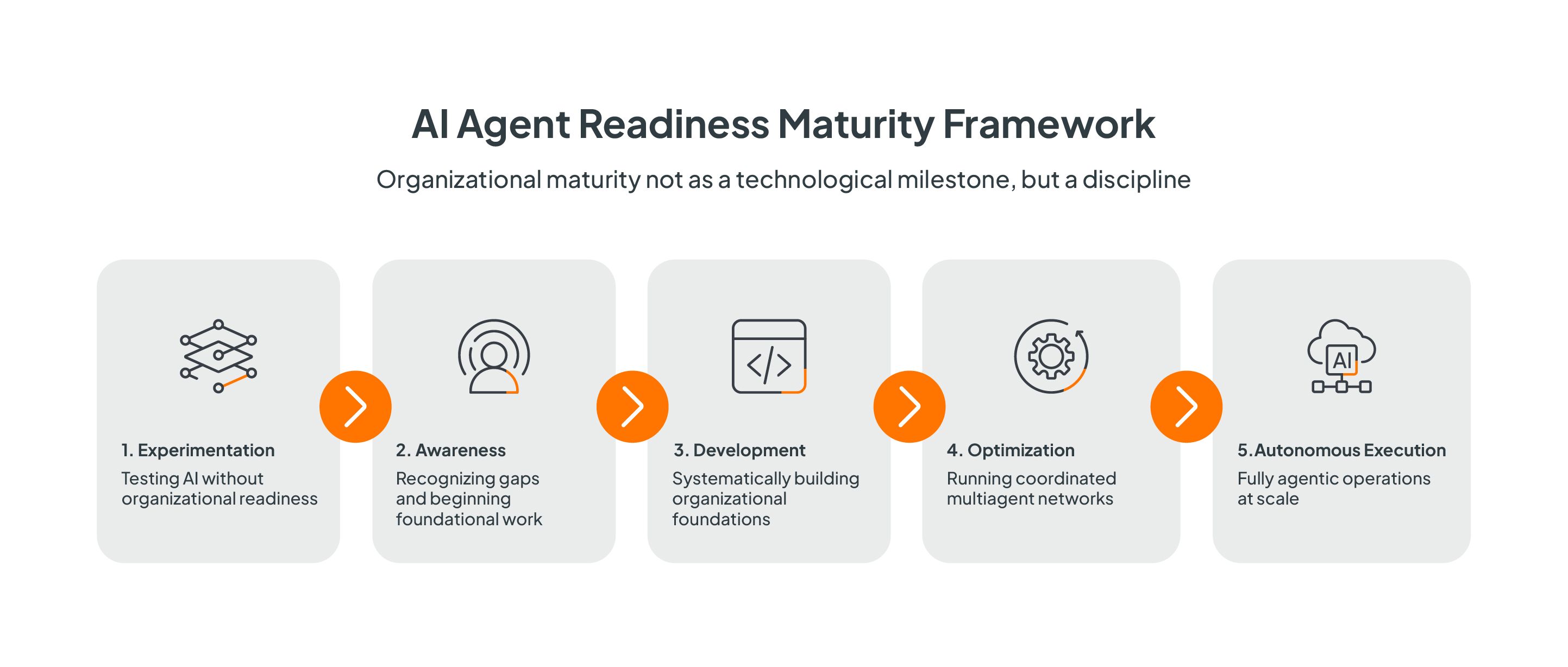
A holistic, AI agent readiness framework emphasizes aligning workforce capabilities, governance structures, and data infrastructure to ensure AI delivers measurable business outcomes.
Analysts now expect a quarter of CIOs and CTOs to rescue failed, business-led AI deployments next year, largely because it was introduced into workflows that were never ready to support it. Bridging this gap requires preparing the environment first:
- Redesign workflows before automating them. AI fails where human patchwork currently keeps processes running.
- Clarify decision ownership. Map responsibilities so that agents act predictably even as autonomy increases.
- Unify knowledge and context. Conflicting rules create inconsistent outcomes that AI will amplify.
- Fix broken handoffs. Agents cannot operate across tools that don’t communicate or integrate with each other.
The TDCX advantage: Enabling AI to create the next trillion dollars of enterprise value
The agentic economy raises the bar for CX. AI must prove its value, interpret the business accurately, and function inside operations without creating risks. These demands will define the enterprise’s success in AI in the years ahead, and they are also where TDCX AI brings practical, grounded expertise.
We’ve spent more than 30 years running large-scale CX environments where precision, empathy, regulatory compliance, and operational nuance determine whether a customer stays or leaves. That experience helps us nurture the environments that empower AI, GenAI, and agentic AI to succeed, especially now that these innovations are increasingly participating in how businesses make decisions and how customers interact with brands.
Participation, however, must be anchored in measurable value. TDCX designs AI-powered CX solutions around problems and outcomes, not technological possibilities. We’ve invested heavily in capabilities that transform raw knowledge into structured, navigable context that allows AI to perform like it belongs in the business, not just beside it.
The next trillion dollars of enterprise value won’t come from AI, but from making it work where it matters. In the agentic economy, organizations need partners who can turn ambition into results, intelligence into action, and autonomy into outcomes that the business can trust.