Blogs
GenAI in Telehealth (Part 1): Use Cases for Improving Patient Support

12 June 2025
By Lianne Dehaye
TDCX AI Senior Vice President
Healthcare used to begin and end with an appointment, but not anymore. As patient expectations evolve and digital health ecosystems mature, it’s becoming more connected, conversational, and increasingly virtual.
In the US, for example, 88% of physicians already rely on centralized electronic health record (EHR) systems to understand their patients. More than 76.% of primary care doctors also say the quality of care they provide through telemedicine matches in-person visits. That confidence, paired with growing patient digital fluency and advancements in remote patient monitoring, is fueling a market boom. The digital health market is projected to reach US$946 billion by 2030, while telepharmacy is poised to grow by 20.42% annually through the next five years.
Beneath the optimism, however, is a system under pressure: 82% of clinicians and healthcare professionals (HCPS) are burning out by the weight of administrative work. In a six-country survey across North America, Europe, and Asia, one in four patients are opting out of care due to delays, confusing instructions, or impersonal service. Even 62% of doctors admit that interactions have become reduced to throughput, fragmented and lacking empathy.
That’s where generative AI (GenAI) can play a meaningful role.
Unlike conventional AI models that predict risks based on past data, GenAI can understand nuance. In patient support, this means interpreting tone, intent, sentiment, and medical to respond with clarity and warmth. It can help patients navigate care plans, decode clinical jargon, or direct complex questions to human experts without forcing them to repeat themselves or wait on hold.
What sets GenAI apart in the HealthTech stack
Traditional AI in telehealth has carved out its role — predictive outreach, anomaly detection, and basic triage, to name a few. However, predictive models don’t know how to speak the language of care when a confused patient messages the hospital in the middle of the night, or when a clinician wraps up notes from a packed day of virtual visits. GenAI brings with it the ability to converse, not just calculate.
GenAI can strengthen telehealth patient support through these use cases:
Real-time clinical summaries: Immediately after or even during a telehealth consultation, GenAI can generate personalized summaries for patients. This reduces the burden on HCPs to manually draft notes and help patients better understand their care plans, driving higher adherence and minimizing confusion.
Contextually adaptive conversational chatbots: When equipped with natural language understanding (NLU) and natural language generation (NLG), GenAI chatbots can adjust their responses based on the patient’s medical history and real-time sentiment. This makes digital interactions feel more natural.
Proactive follow-ups: Instead of static reminders, GenAI can initiate timely and personalized reminders (e.g., medication refills, scheduled lab tests, tailored wellness recommendations) directly tied to the patient’s unique healthcare journey. This personalized outreach help prevent gaps in care while keeping the patient engaged between visits.
Together, they illustrate GenAI’s role as an integral frontline asset. By improving how information is delivered, questions are answered, and follow-ups are handled, GenAI helps healthcare providers streamline patient support. In one case study, it cut administrative time by 30%. It’s no surprise that 85% of decision-makers are investing in GenAI to drive efficiency and productivity.
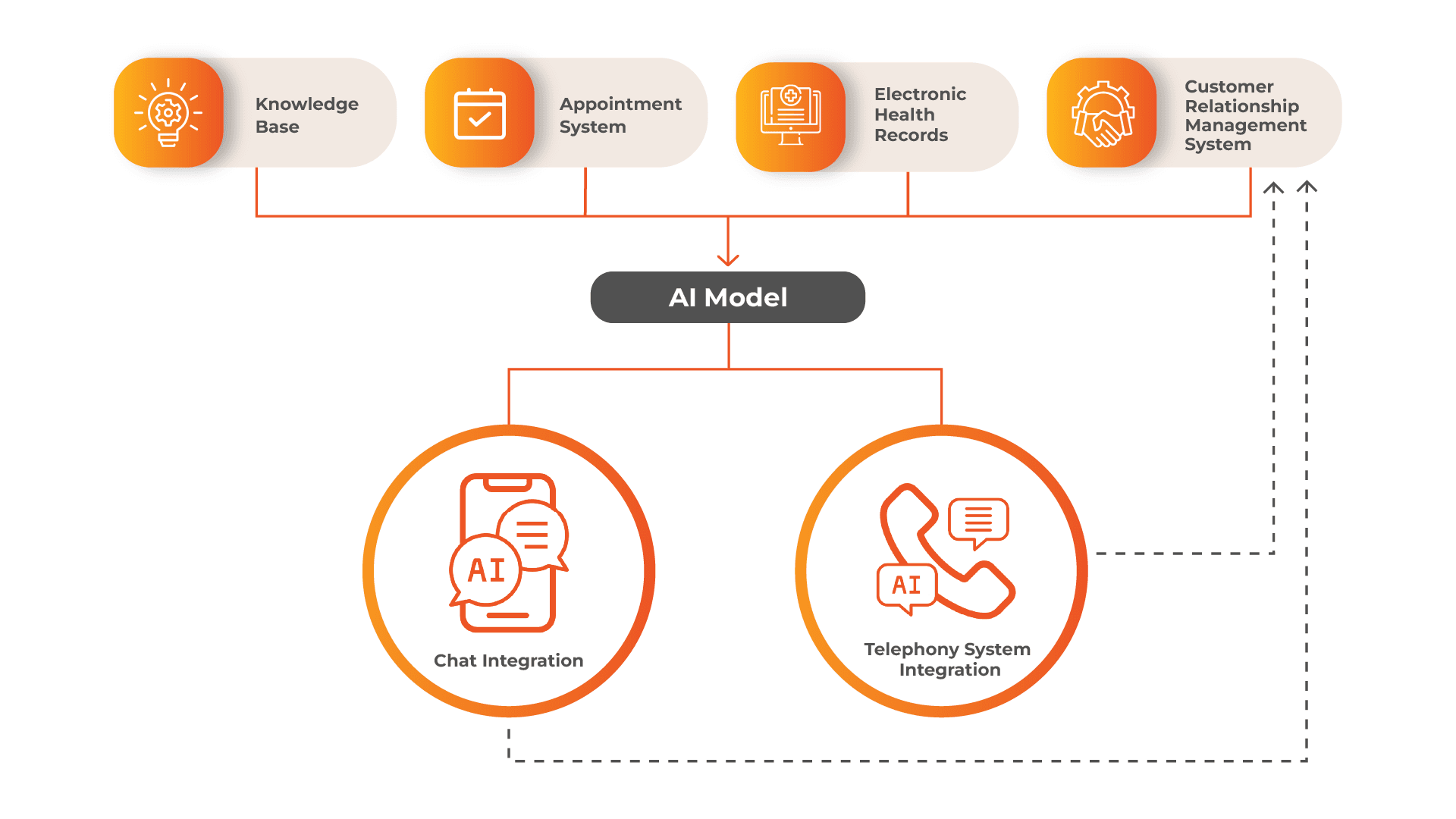
Figure 1: Visualized workflow of a GenAI-powered virtual agent or chatbot, where data feeds into the AI model that, in turn, is integrated into a telephony system; these agents can engage patients directly through voice- or text-based interactions, with human oversight in place to monitor interactions and continuously improve performance
GenAI use case in telehealth: AI virtual agents
AI virtual agents are voice-based digital assistants that use generative AI models to manage real-time patient interactions over the phone. Unlike traditional interactive voice response (IVR) systems or scripted voice bots, these AI agents are built on LLMs fine-tuned with clinical triage protocols, patient interaction transcripts, and healthcare documentation. They’re designed to interpret spoken language, assess urgency, and respond in a way that mirrors how a trained staff member would, and within medical protocols and compliance standards.
Here’s how this could work in practice: A patient calls a telehealth hotline, describing flu-like symptoms. The system immediately begins with real-time speech-to-text transcription, identifying medically relevant keywords. The GenAI engine processes the query against a structured triage framework while analyzing tone and urgency. It also references the patient’s profile, such as past visits, chronic conditions, and known allergies, to contextualize the interaction. The virtual agent then determines if the case requires same-day care. It communicates this clearly, offers a list of available slots, and books the appointment with no manual escalation needed.
This isn’t just automation. When integrated with telephony systems and clinical databases (via APIs), AI virtual agents can scale patient triage while preserving service quality. They provide immediate support beyond business hours, reduce wait times, and give staff more time to handle complex cases. For healthcare providers, the result is a measurable improvement in efficiency, faster routing to appropriate care, and higher patient satisfaction.
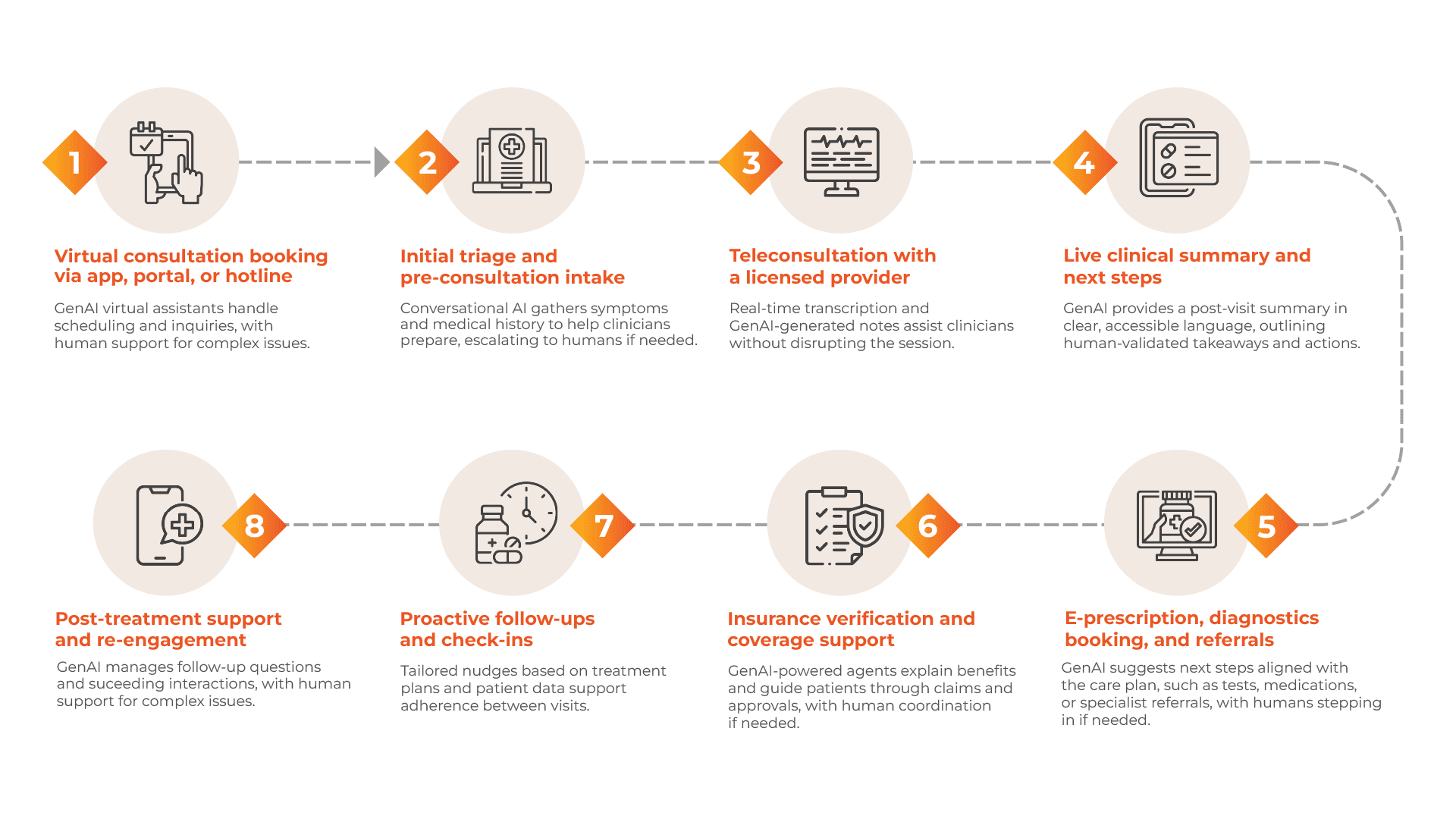
Figure 2: A visualized telehealth journey showing where GenAI can actively support patient interactions, from intake, consultation, and follow-up to ongoing care
GenAI use case in telehealth: Conversational chatbots
Imagine a patient logging into their portal after receiving an abnormal lab result. They start a chat asking what the result means. The chatbot identifies the specific test, cross-references the patient’s condition history, and explains the result in plain language. It then offers contextual next steps, like scheduling a follow-up with their physician or flagging symptoms to monitor, all within the same interface.
Unlike rules-based bots constrained by rigid scripts, GenAI-powered chatbots use LLMs and NLU to interpret patient questions and identify intent, detect uncertainty, and parse clinical terms. Paired with natural language generation (NLG), the chatbot then formulates and crafts responses that mirror how a trained support agent might respond. These LLMs, integrated directly into patient portals, customer relationship management (CRM) platforms, and clinical knowledge bases, allow them to deliver personalized and context-aware responses based on each patient’s medical history, care plan, and even health literacy level.
Another real-life example would be a GenAI chatbot reminding a patient to complete their intake form ahead of an upcoming appointment. When it detects that the question about current medications was left blank, it prompts the patient to answer. Based on the response, it dynamically adjusts its next question, asking about family history of chronic conditions. This seamless, adaptive exchange improves data completeness and supports better clinical preparation.
When deployed at scale, GenAI chatbots can help deflect routine inquiries, reduce contact center volume, and increase patient comprehension, all of which drive higher satisfaction and better adherence to care. In one North American medical center, for instance, their conversational AI chatbot designed for scheduling and registration has helped the hospital increase appointments by 47%. In another study in Southeast Asia, AI-augmented hybrid chatbots increased patient engagement by 30% and reduced wait times by 15%.
GenAI use case in telehealth: AI-powered knowledge bases for CX and frontline staff
Unlike static FAQ repositories or scripted response systems, these dynamic knowledge bases (KBs) use fine-tuned LLMs to generate medically compliant responses, sometimes even in real time. Integrated with CRM systems, EHR platforms, and knowledge management tools, they give CX agents and clinical staff instant access to up-to-date medical content and structured patient information.
These AI-powered KBs typically include the following:
Real-time speech-to-text transcription: Integrated with telephony and virtual care platforms, GenAI speech models can transcribe conversations between patients and HCPs. These transcripts feed directly into EHRs and drive downstream tasks like summarization, documentation, and audits.
Context-specific responses: GenAI models trained on clinical language can generate responses grounded on the patient’s history, care plans, prior interactions, and curated KB entries. These responses adhere to approved communication guidelines, ensuring consistency, brand alignment, and regulatory compliance.
Persistent context and memory retrieval: Using NLP and dialogue system design techniques, GenAI can maintain continuity across multiturn conversations. This allows the system to “remember” past topics within the same session or retrieve relevant information from prior visits, reducing repetition and enhancing personalization even across asynchronous interactions.
Recommendation engines: By integrating with structured medical datasets and patient-specific records, they can suggest relevant follow-up actions, such as lab tests, provider referrals, wellness programs, or product suggestions tailored to the patient’s needs.
Automated compliance verification: Outputs pass through compliance layers that check for adherence to regulatory frameworks and medical communication standards. These flag sensitive data exposures, outdated clinical guidance, or noncompliant phrasing before delivery, help reduce legal and reputational risk.
Multilingual response generation: Healthcare-tuned translation techniques help GenAI deliver tone-consistent responses across different languages. This ensures patients receive clear, localized communication, which is particularly valuable in global or diverse healthcare settings.
For healthcare providers managing high patient volumes across multiple regions and languages, these GenAI capabilities offer a way to scale operations and customer service while maintaining consistency and compliance.
A similar strategy has already proven effective in other high-touch industries. For example, we built a conversational AI KB to enable a travel company to manage high-volume customer inquiries. Trained on the 40 most frequently asked questions, the system helped CX agents reduce search time by over 66%, with a 97% accuracy rate on routine queries. Instead of combing through static documents, support teams accessed concise, context-aware answers in seconds. This approach can also be adopted to ease cognitive load on staff, speed up response times, and enable more informed interactions.
Indeed, realizing GenAI’s potential in telehealth requires both domain expertise and technical capabilities. This includes curating high-quality training data and integrating the technology into GenAI-ready, future-proof IT and communication infrastructures. More importantly, patient experience and CX strategies must align with the realities of clinical operations — not just automating responses or digitalizing interactions, but improving the quality and continuity of care. Operationalizing GenAI in telehealth means navigating healthcare’s complexity with precision and empathy while delivering measurable value.