Blogs
Infographic: What’s the CX Score for AI Chatbots in E-Commerce, Retail, and Banking So Far?

18 May 2025
By 2025, experts anticipate that 85% of service interactions will be AI-driven, with over 80% of organizations using generative AI (GenAI). AI-powered chatbots are being positioned as the go-to for customer support, but how far have they really come for e-commerce, retail, and banking?
Findings from TDCX AI’s mystery shopping exercise — assessing conversational aptitude, task completion, and user experience — highlight both progress and limitations. Chatbots were assessed on their capacity to handle natural, humanlike conversation, including the ability to interpret spelling variations and synonyms. Simple exchanges were handled well across both industries. Banking and finance chatbots scored 75%, indicating stronger competence in organized transactional queries. A 50% score in e-commerce and retail reflected a reliance on keyword-triggered responses that often resulted in repetitive interactions.
Overall, conversational aptitude across both industries landed at 63%. While chatbots can initiate conversations, their ability to understand and adapt still requires refinement.
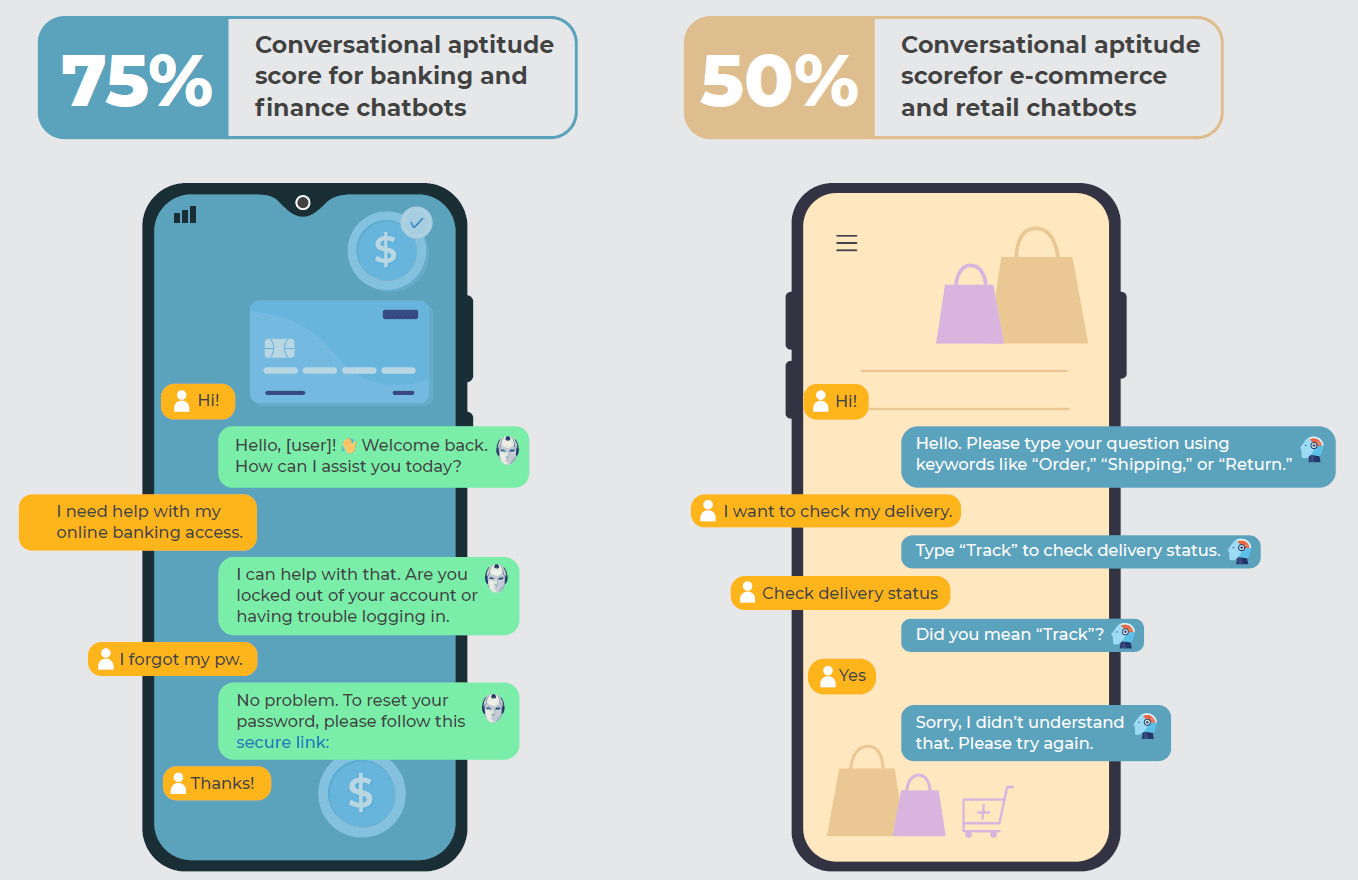
Based on our mystery shopping exercise, banking and finance chatbots handled natural language better. E-commerce and retail chatbots often relied on preset keywords and missed conversational cues. Download the infographic through the link below, which provides more insights on how the chatbots fare across the two industries.
A chatbot’s success depends not only on how well it talks, but on whether it can deliver a resolution. In this category, e-commerce chatbots performed strongly with a perfect 100% score, resolving all test scenarios without the need for escalation. Banking and finance chatbots, however, scored 75%, with some interactions requiring human intervention to complete tasks.
Overall task effectiveness across both industries was 87.5%, highlighting a key strength of AI in e-commerce: When the process is predictable and predefined, chatbots perform well. Effectiveness dips when interactions become complex or compliance-heavy (such as in banking), or when the query needs deeper context and reasoning that it requires multiple steps to resolve.
For UX, an average score of 85% was recorded across the industries, with particularly high marks for ease of use and technical stability. However, notable differences emerged:
E-commerce chatbots excelled at escalation, smoothly connecting users to live agents when needed. However, banking chatbots struggled with seamless handoffs.
Banking chatbots had stronger back-end integration, while e-commerce bots occasionally encountered system disconnects.
Download the infographic for a visual snapshot of how chatbots in e-commerce and banking are performing. Explore the data, compare industry scores, and uncover where AI in CX is making strides and where it still needs work.