Blogs
Why AI for CX Fails (Part 4): Humans as the Greatest Asset or the Weakest Link

23 September 2024
You’ve covered all your bases to launch your AI-powered chatbot. Bad data? You fed it high-quality inputs. Hallucinations? You fine-tuned the algorithms. Legacy system crashes? You moved to the cloud and upgraded your infrastructure. On paper, everything is set for success — but when you finally roll it out, you face your biggest roadblock yet: humans who don’t want to use it.
This scenario isn’t hypothetical: Despite 60% of financial institutions ramping up their investment in AI to enhance digital services, nearly 70% of decision-makers are hitting a wall. Employees worry that AI will push them out of their jobs, while IBM’s report notes that almost 40% of CEOs worldwide admit that they don’t fully understand how their AI-driven strategies affect their people.
Machines have been transforming human productivity for decades, and this evolution will continue as more tasks and routine decision-making become automated. This doesn’t mean that humans will be replaced. Instead, they’ll remain in the loop, shift toward higher-value work, and open new opportunities. In fact, generative AI (GenAI) is projected to increase global GDP by 7%. Contact center leaders, too, are increasingly investing in AI that, according to a recent Thomson Reuters survey, could save at least four hours a week in 2025. That’s nearly 200 hours per person, which can be reinvested into what they want to focus on: improving their work-life balance.
The real power of AI lies in collaboration rooted in human insight and oversight. In this last part of series on why AI for CX fails, we’ll explore how humans play the most crucial role in adopting AI — whether as the company’s greatest asset or its weakest link.
C-level participation and buy-in
CEOs who’ve witnessed countless tech trends rise and fall might view AI as a risky disruptor to the business model they’ve spent years refining. The CFO could add another layer of concern — the cost of implementing AI is substantial. While maintenance usually runs about 10% – 30% of deployment costs, keeping GenAI-powered systems running can cost as much as building them in the first place. The potential benefits are tempting, but the returns are far from guaranteed.
Meanwhile, the COO would be focused on operational challenges. Integrating AI into an existing CX framework isn’t as simple as flipping a switch. It could mean overhauling workflows, retraining staff, and, alongside the CTO, reengineering the entire infrastructure. Such an operational shake-up could do more harm than good.
Thankfully, more C-level leaders are recognizing the importance of AI. In fact, over 60% of executives rank GenAI as a top three priority for the next two years. Only about 35%, however, have a clear plan for turning GenAI into real business value.
The disconnect highlights a critical need for strategic alignment at the top. When the leadership team champions AI initiatives, they’re not just side projects but a part of the company’s core strategy. This is crucial because AI projects require significant financial, human, and technological resources. Without full buy-in from the C-suite, securing these resources can be a major hurdle. To secure this buy-in, the AI solution must be worth its salt, providing tangible value with clear use cases as well as demonstrating measurable benefits and contributions to the bottom line. Indeed, nearly half of surveyed enterprises in the US, the UK, and Germany said that estimating and proving business value is their top hurdle when implementing AI and GenAI.
Organizational culture and overcoming resistance
For many organizations, introducing AI could be a paradigm shift — and change, as any seasoned leader knows, can be a tough pill to swallow.
AI challenges how companies operate and the ways their people work. Case in point: A 2024 IBM survey found that nearly two-thirds of CEOs are pushing their companies to adopt GenAI faster than their people are comfortable with. Employees, many of whom have spent years perfecting their customer service skills, understandably feel threatened that the technology could reduce their roles to merely pushing buttons. This skepticism can quickly turn into resistance that, over time, becomes deeply ingrained in the company culture. Overcoming it requires a multifaceted approach, starting with clear, transparent communication.
Employees need to see AI as a tool that enhances their skills, not something that makes them obsolete. By framing AI as an enabler, companies can shift the narrative from fear to opportunity. Empowering employees also entails holding ongoing dialogue, actively addressing concerns, and providing regular updates. When employees feel that they’re part of the process, they’re more likely to embrace the change. This could mean involving frontline staff in selecting and testing AI tools or creating cross-functional teams that bring together AI experts and end users to implement new technology.
Adopting AI is as much about managing people as it is about managing technology. Organizations need to commit to ongoing training and development, and, like any big initiative, measure AI’s success not just by how well the tech performs, but also by its impact on people. Metrics like employee engagement, customer satisfaction, and operational performance give a fuller picture of whether the AI initiative is truly hitting the mark.
AI proficiency and data literacy
Many organizations might have the technology in place but lack the human know-how to fully tap into its potential. This gap could mean employees struggling to operate AI-powered tools or interpret AI-driven recommendations.
For AI to be effective, it’s not enough for employees to just use the tools. They also need to understand the data behind them. The problem is compounded by a striking finding that 90% of executives and IT leaders surveyed across the US and the UK admitted that they “don’t completely understand their teams’ AI skill and proficiency.” If leaders don’t know where their people stand, it’s tough to figure out where to go and how to start with AI.
Bridging this gap requires building expertise. It entails strengthening training where skills are lacking and teaching employees how to better understand data. Proficiency doesn’t mean everyone needs to become a data scientist or an AI engineer, but they need to have the practical knowledge to interpret the AI solution’s outputs, verify the insights it generates, and ensure that its recommendations are grounded in reality. In CX, this means empowering human agents to use AI and data to deliver more personalized, responsive, and effective customer interactions.
Countering human biases in AI
Despite their seemingly objective nature, AI systems are ultimately created by humans and trained on data generated by human behavior. The biases we carry — willfully or unconsciously — can be inadvertently encoded into AI systems.
An approach through the human lens involves bringing diverse, interdisciplinary teams into the development process. A McKinsey research, for instance, found that diverse development teams are three times more likely to outperform their counterparts in AI projects. In another case study in South Korea, AI models designed to predict symptom severity — and improve healthcare delivery — saw higher accuracy when developed by teams with a balance of genders.
Diverse teams bring varied perspectives that spot blind spots and scrutinize unexamined assumptions. For instance, a diverse team working on an AI-driven customer service tool might notice that the system’s language-processing algorithms struggle with nonstandard dialects or accents. By catching this early, they can retrain the AI model with a more representative dataset.
This underscores another key element: humans in the loop (HITL).
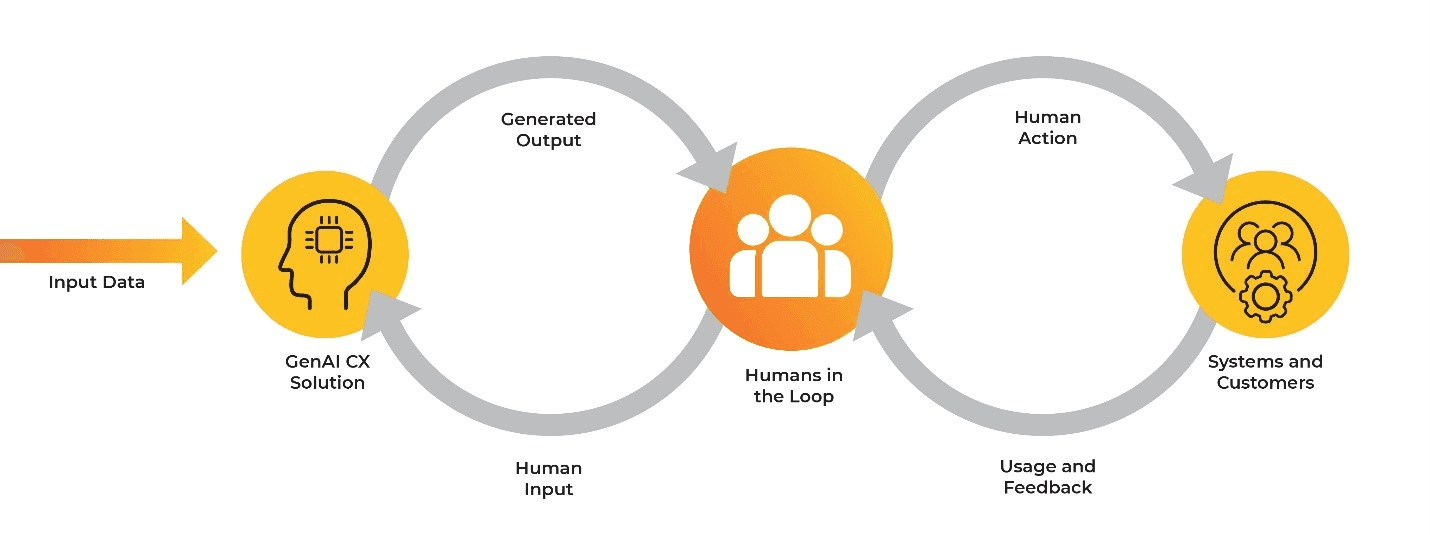
A sample scenario of HITL in CX could involve human agents using a GenAI-powered tool to respond to a customer inquiry, where they review the automated reply, provide feedback, add context, and fine-tune the message before sending it to the customer. In turn, the interaction can feed valuable feedback into the GenAI tool to refine its accuracy and relevance.
HITL keeps humans actively involved in the AI decision-making process. For instance, in content moderation on social media or gaming platforms, human moderators step in to review and make the final call after an AI system flags posts or comments. This keeps the AI system’s decisions in check, ensures that context and nuance aren’t lost, and mitigates biased or unfair outcomes.
HITL also helps maintain accountability in AI-driven CX. Customers are more likely to trust an AI system when they know a human is involved — someone who can step in, explain decisions, and address concerns. In fact, 81% of consumers and business buyers in 25 countries surveyed in 2023 stressed the importance of humans reviewing and validating the outputs of AI in customer interactions.
Having humans in the loop is also important for algorithmic transparency. AI systems often operate as “black boxes,” where the decision-making processes are opaque even to those who designed them. This can be problematic, especially in customer-facing applications where decisions made by AI — such as recommendations, pricing, or eligibility for services — directly affect customers.
Consider an AI-powered CX system used by a financial institution to determine creditworthiness. If a customer is denied an offer or promotion based on an AI-driven assessment, they have a right to understand why that decision was made. However, if the AI’s decision-making process is opaque, it becomes difficult to provide a clear explanation and thus raises concerns about fairness and accountability. This can lead to distrust, particularly if customers believe that the AI system is making biased or arbitrary decisions. Companies might run afoul with the EU AI Act, for example, which imposes penalties and mandates specific obligations for various kinds of AI systems, including clear documentation on how AI systems work and their risk level.
As AI continues to evolve, new roles and skills will remake the CX workforce. Data literacy will be a must across the board, and new roles will emerge to manage AI systems. The future of CX will hinge on the collaboration between humans and AI playing to their strengths. AI can take on the routine, data-heavy, and number-crunching tasks, while human employees focus on what they excel at: building relationships, delivering personalized service, and making judgment calls in complex situations.
The upcoming TDCX Talks: Creating Powerful CX in the Age of AI, happening on October 10 at Marina Bay Sands, Singapore, will unpack these ideas with practical insights and real-world success stories. The event brings together industry leaders, innovators, and experts to discuss the latest trends in AI-driven customer experience and the ever-important role humans will play.